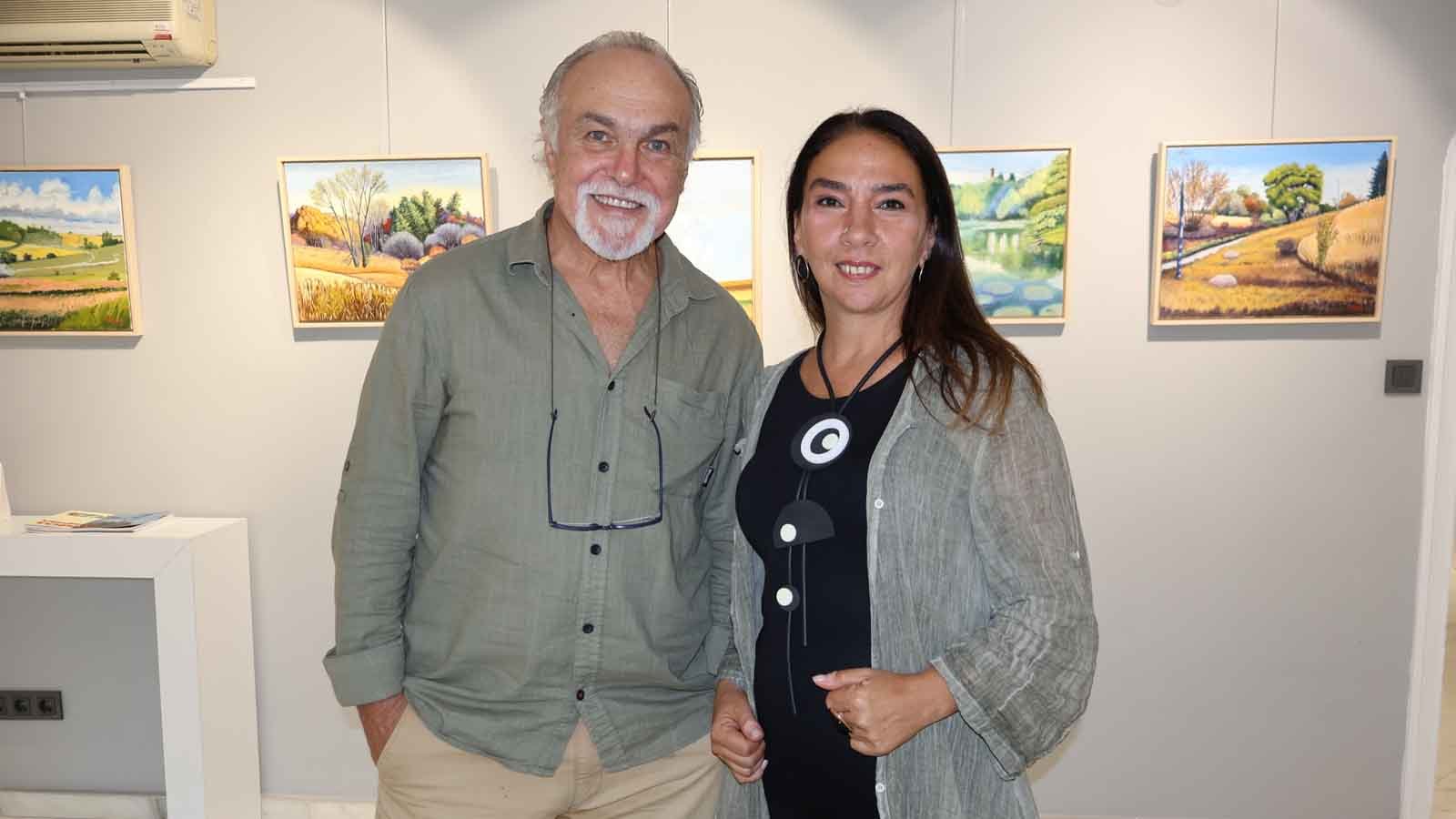
This episode of “The Evolution of Art” took place in the studio of experienced painter and mosaic artist Süha Semerci in Istanbul. The program unfolded as a deep and enjoyable conversation, spanning from how the artist synthesized his “self-taught” and “academically-trained” accumulation to contemporary mosaic art and the place of artificial intelligence in art.
Both Self-Taught and Academically-Trained: A Multifaceted Accumulation
Süha Semerci began his artistic journey in Çivril district of Denizli. During his high school years, he worked in sign-making, printing, and photography, building a strong foundation in graphics and production processes. He noted that the lack of a master to ask questions during this period pushed him to constantly research and learn through trial and error. He later came to Istanbul and studied at the then-named Tatbiki Güzel Sanatlar Okulu (today’s Mimar Sinan Fine Arts University). He described the merging of his “self-taught” experience with academic education as a major advantage. His workshop experience enabled him to better grasp and apply the techniques he learned in school. For instance, he recounted gaining the ability to see even blank newspaper sheets leftover from printing in the press as an art object.

An “Invention”: The Reverse Tricolor Printed Mirror
In 1988, while working on mirror decoration, Semerci achieved a significant technical innovation. He solved a request from a foreign company to print on a mirror surface using an unconventional method. He developed a technique where the last printed color in the traditional process, black, was printed before the mirror was silvered, thus trapping the print inside the mirror. This process also brought challenges, such as deleted paints leaving thin traces on the glass. The resulting “reverse tricolor printed mirror” astonished the client from France, making them question how such a product was made in Turkey. Semerci mentioned that he struggled for a long time to get a patent for this technique and even had dreams of transferring this invention to three-dimensional printing.

Encounter with Mosaic and “Contemporary Mosaic from Anatolia to the World”
Semerci’s real and lasting encounter with mosaic began when he was invited to a mosaic symposium in Gaziantep. He emphasized that at that time, mosaic in Turkey was often associated with low-quality applications on building facades, but what mattered was not the material itself, but how it was used. Based on this view, in 2013 he prepared his first thematic exhibition titled “Contemporary Mosaic from Anatolia to the World.” In this exhibition, he reproduced images of ancient mosaics he selected from Antep and Antakya museums, using today’s glass mosaic material instead of the original natural stone. His goal was to capture the same visual impact and quality of the two-thousand-year-old work with contemporary materials. Later, by incorporating his own interpretations and interventions into these ancient forms, he began creating an original language that carries tradition into the present.
Turkey’s Mosaic Potential and the Preservation Problem
Semerci argued that Anatolia possesses the world’s richest mosaic treasures, but this value is not sufficiently recognized. He stated that museums in cities like Gaziantep, Hatay, and Şanlıurfa, along with ongoing excavations, contain unique examples. He pointed out that the source of mosaic iconography in many churches in Europe is the mosaics in Istanbul (Hagia Sophia, Chora Museum). However, he expressed concerns about the preservation of these treasures. He explained that a mosaic is safe underground, but when unearthed, if not preserved under proper conditions, it can face the danger of disappearing, sometimes even due to temporary covers placed for protection (which, due to factors like rain and frost) can cause permanent damage. Therefore, he stressed that not only discovery, but also preserving under the right conditions and passing it on to future generations is of vital importance.

Footprints and the “Istanbul 2020” Project
Semerci is working on a long-term mosaic series about Istanbul. This idea was born from the question, “I lived in this city, but what did I do for it?” He said that people who lived in this city before him left behind buildings, poems, songs, and that he wanted to tell about Istanbul in his own language, which is mosaic. He noted that traditionally it is difficult to sign a mosaic, so he developed a unique signature resembling an exclamation mark, which he calls a “footprint,” placed in the lower right corner of his works. In the works he prepared for the “Istanbul 2020” exhibition, which was postponed during the pandemic, he now placed these footprints within the composition, as traces of a figure wandering in Istanbul. Sharing an emotional moment he experienced when leaving his studio during the pandemic, Semerci explained that after this process, the footprint theme transformed into abstract compositions and he produced small 30×30 cm series.
Artificial Intelligence and Fantastic Mosaic Worlds
Recently actively engaged with artificial intelligence (AI), Semerci uses this technology to explain and disseminate mosaic art. He sees AI as a tool to visualize the fantastic mosaic stories he imagines. He creates fun and educational visuals featuring historical characters like Roman Emperor Julius Caesar and Queen Cleopatra, wandering in today’s Istanbul, in his studio, chatting with them, even taking them on vacation. He stated his aim is to endear the history and techniques of mosaic to a wider audience through these creative and fantastic narratives. He emphasized that in using AI, previously acquired knowledge and experience are very important. Making the analogy, “Driving a car in an empty field is one thing, driving in traffic knowing the rules is another,” he underlined that deep domain knowledge is needed to properly direct the power of AI. Comparing AI to a “grenade with its pin pulled,” Semerci expressed that wonderful results can be achieved when used correctly and with good intentions, but uncontrolled use can be dangerous.
Dreams and Future Projects
Süha Semerci has many dream projects he wants to realize:
Mosaic Academy: He wants to establish a mosaic academy in Turkey that would attract students from all over the world, providing both theoretical and practical education, while also offering the opportunity to research Anatolian mosaics.
Contemporary Mosaic Museum: He feels the lack of a contemporary mosaic museum in Turkey and strives for it.
Anatolian Mosaics Documentary: He mentioned he prepared a documentary project explaining the techniques of Anatolian mosaics and their interrelationships, but has put it on hold for now due to producer issues.
Autobiographical Documentary: He is working on a personal documentary in episodes, telling the story of his 65-year life and artistic journey.
Art Valley Dream: He described his biggest dream to realize if given unlimited possibilities: to establish an “art valley” by the sea, containing everything from workshops to guest houses, from libraries to exhibition halls, where artists from all over the world could come to produce and research.
Advice to the Young: Patience and Dedication
He offered “patience” and “education” as advice to young people who want to engage professionally with mosaic and art. He said this work requires the courage to sustain one’s life solely by earning from it. He emphasized that doing a job with love removes it from being just a “job” and turns it into a lifestyle. Describing his own studio as his “world,” Semerci expressed that he feels he exists and breathes as long as he is there.