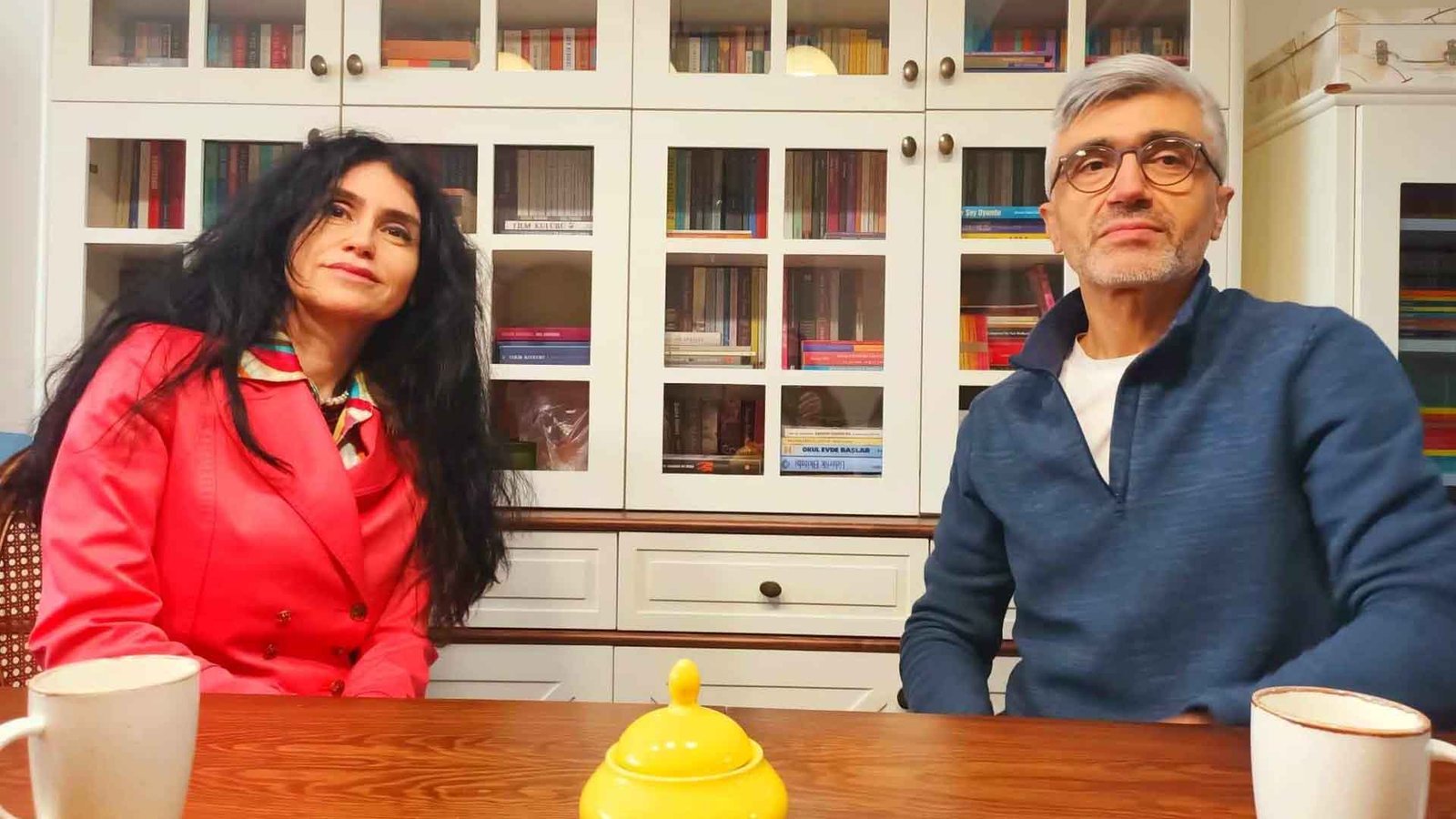
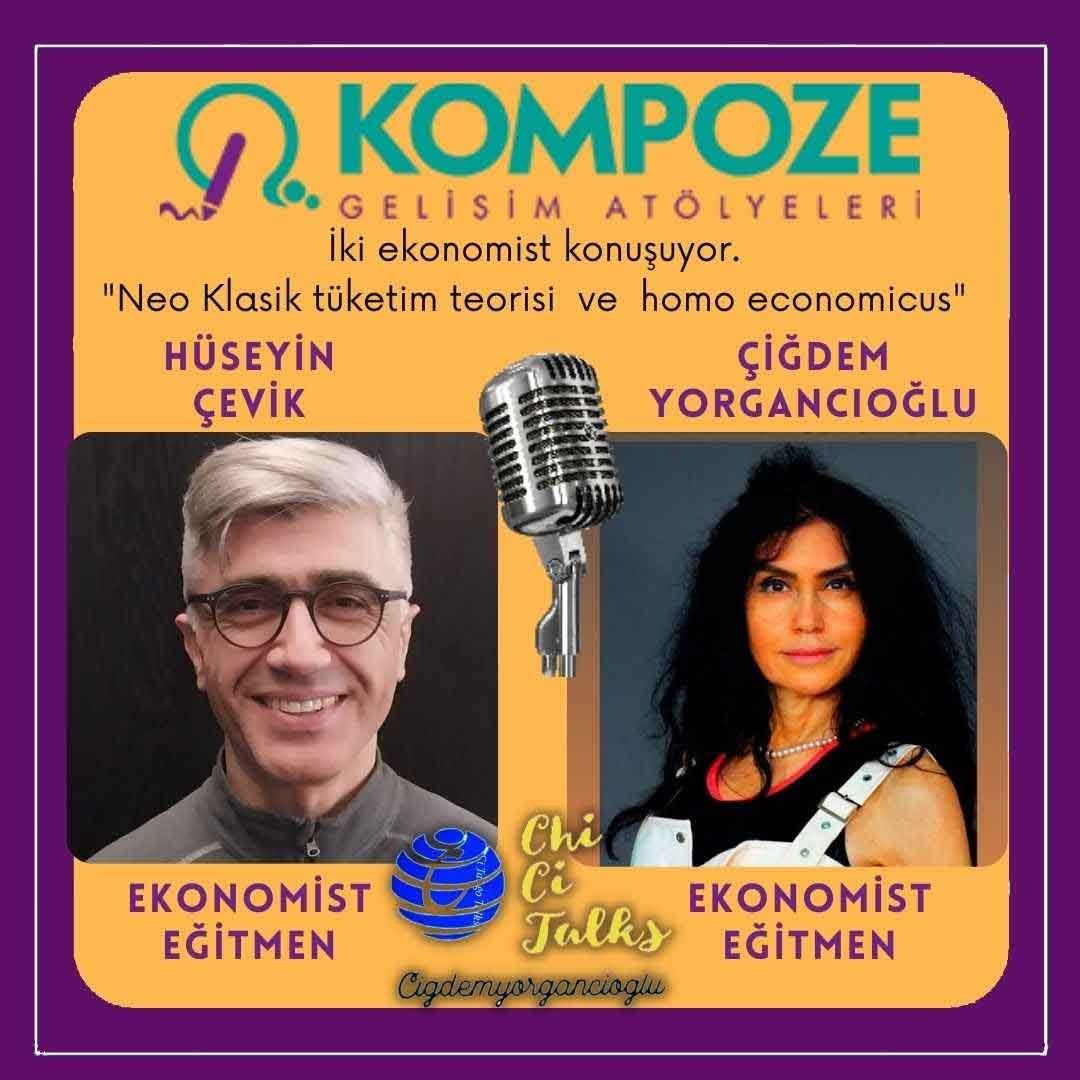
KOMPOZE Development Workshops have resumed Chi Ci Talks discussions at its new location in the new season, with Economists Çiğdem Yorgancıoğlu and Hüseyin Çevik leading a conversation on the Neoclassical Approach to Economic Doctrines and the Condition of Homo Economicus in Today’s World.
The main focus of the discussion was on the rapid brainstorming of doctrines from the economic thought history, especially from the Industrial Revolution to the present day, and their national and global impacts and contexts. Within approximately 44 minutes, the conversation touched upon meticulously designed new programs under each future heading (4X4), intended for broadcast, making it a comprehensive discussion. The first part of this conversation, where various assessments are made on a global and historical scale, can be watched both audibly and visually, while the remaining 22 minutes, constituting the second half, can be followed only by listening.
After the education, Chi Ci Talks producer and Anchor, Cigdem Yorgancıoğlu, said the following:
“First of all, I would like to thank everyone involved in the process. It was like a brainstorming session, a necessary initial stage for dimensional analysis of the reflection of the approach that leaves the labor theory, which is central in the Classical school and based on the theory of surplus value, to Neoclassical economics, to the policies of the day. Getting feedback that it was an informative, thought-provoking, and research-encouraging conversation for the listeners during and after the broadcast made both of us happy. In the future, according to the requirements of your busy schedule, it also encouraged us to continue these economic conversations and curriculum planning in the planning phase at regular intervals. In this regard, we would also like to thank our viewers.”
In the opening parts of Çiğdem Yorgancıoğlu’s talk, after referring to the times when economic norms began to break down by saying “We were born into the stagflation era,” and being inspired by Hüseyin Çevik’s narrations in CHI CI TALKS, she wrote some lines from her article, which also referred to the interview, as follows:
“In a section of the conversation that focuses on criticisms of Orthodox Neoclassical Economics from Economic Thought Doctrines, when Hüseyin Çevik emphasized how the Treaty, which allowed British citizens to trade in Ottoman territory, paying even less tax than Ottoman citizens, and granting privileges, brought a windfall to the Textile industry, and also referred to the book “Kicking Away the Ladder”;
The Treaty of Balta Liman, also known as the Treaty of Balta Liman Trade, signed in 1838 between the Ottoman Empire and the United Kingdom in the Balta Liman district of Istanbul, provided the Ottoman Empire with economic privileges in many respects to the United Kingdom. This agreement highlighted how historically the textile sector began to disappear.
Let’s leave the name of the book here for easy reference in the footnote Ha-Joon Chang, Kicking Away the Ladder: Development Strategy in Historical Perspective. The book (London: Anthem Press, 2002–ISBN: 1-84-331027-9). By the way, for those interested, I recommend reading Şevket Pamuk’s “150th Anniversary of the Balta Liman Trade Treaty.”
FIRST WORLD
The concept of the First World refers to the countries that allied with the United States and other Western countries to oppose the Soviet Union and its allies during the Cold War period. These were capitalist, industrialized countries, which were non-theocratic and democratic. During the Cold War, all NATO countries are considered First World countries. After World War II, it refers to a bloc of countries that aligned closely with the U.S., having very few political and economic interests. We are talking about countries like North America, Western Europe, Japan, and Australia. After the dissolution of the Soviet Union in 1991, the usage of this term evolved. Today, the term “First World” is mostly used to describe industrialized and developed countries. Some fundamental parameters of a First World country include political stability, democracy, rule of law, and economy. A high standard of living is also a characteristic of First World countries. On the other hand, when we look at the key performance indicators (KPIs) or criteria used to explain the concept of First World nations, we see that experts, including academics and international policy practitioners, rely on various measurements to define First World countries, from gross domestic product (GDP) or gross national income (GNI) to literacy rates. The Human Development Index (HDI) is another criterion used to analyze the development of countries, covering economic and social aspects, implemented by the United Nations. The HDI, which includes dimensions of education, life expectancy, and standard of living, is typically measured on a scale from zero to one, where zero indicates very low levels of human development.
During the Cold War, modernization theory and development theory developed in Europe as a result of economic, political, social, and cultural reactions to the administration of former colonial regions.
Since the 19th century, people have argued that the prosperity of the First World is the result of its commitment to unlimited economic freedoms. South Korean economist Ha-Joon Chang, in his book “Kalkınma Reçetelerinin Gerçek Yüzü” translated as “The Real Face of Development Recipes” or “Kicking Away the Ladder,” published in 2003, argued that the situation is not quite like that and that the economic success of the First World actually stems from state interventions of the kind that traditional economic thought consistently opposes today. Chang’s detailed analysis of how Britain and especially the U.S. came to dominate the emerging global economy highlighted their willingness to use state apparatuses to achieve such results. Chang also argued that the financial, legal, and institutional structures purportedly necessary for the West’s economic power were actually products of its economic dominance rather than levers that helped it achieve economic success.
CHI CI TALKS ‘TRACES OF DEVELOPMENT PRESCRIPTIONS AFTER THE BROADCAST
Contrary to the claim or belief that today’s developed countries developed with laissez-faire laissez-passer, free-market policies, and basic democratic institutions with a physiocrat mindset similar to Chang, who advocates the idea that they did not develop, our instructor Çevik approached with a similar perspective. Unlike Orthodox Neoclassical policies, he emphasized that he was on the heterodox side.
In short, Chuang emphasizes the paradox that many of today’s high-income countries, that is, the “First World” countries I tried to emphasize above, did not follow the policies they prescribed while climbing the economic success ladder in the nineteenth century. On the contrary, he emphasized that these countries applied high tariffs and sectoral industrial policies. Chuang also said they were delayed in implementing democratic reforms. He even touched on ethical elements, saying they stole industrial technologies from each other. His statement that there were no Independent Central Banks was also not without reason. According to Chang, advanced countries were hypocritical when they tried to prevent developing countries from accessing the same policy tools and encouraged them to adopt democratic reforms and protect intellectual property rights.
According to Chang, developed countries today preach the policies of Adam Smith, the advocate of “free-market orthodoxy,” to developing countries. However, in the past, they followed the policies of Friedrich List, the advocate of state intervention and heterodoxy. Advanced countries, in Friedrich List’s famous phrase, are “kicking away the ladder” they used to enrich themselves (reference to the book) and instead try to impose on developing countries a set of policies that do not fully correspond to their economic situation and contradict their economic interests.
This article concludes some lines of this paper. See you in a new Chi Ci Talks.
CIGDEM YORGANCIOGLU ECONOMIST INSTRUCTOR
SAMPLES FROM PUBLISHED BOOKS – aRTSHOP – New World Order Tango With She Elephants and He Horses
Specialization and/or Areas of Work Eastern Mediterranean, Energy Policies, Economic Politics, Energy Economics, Economic and Political Doctrines – Fallacies in the World of Economics New World Order-Innovation IT Telecommunications and Digital Technologies-Information Security -Forensic Informatics
HÜSEYİN ÇEVİK – ECONOMIST INSTRUCTOR
EXAMPLES FROM PUBLISHED BOOKS White Pen KPSS Macroeconomics Topic Illustrated
Specialization and/or Areas of Work Microeconomics Macroeconomics-International Economics -Economic Growth-Development -Turkish Economy-Money Bank -Economic Doctrines History
Kicking Away the Ladder was awarded the 2003 Gunnar Myrdal Prize by the European Association for Evolutionary Political Economy.